The Frame Width Problem: Why Your Specs are Triggering Change Orders
Most elevator smoke curtains are bid based on a standard 2-inch frame. But when Otis, KONE, thyssenkrupp or Schindler submittals come in at 3 or 4 inches or more, your coordination fails. Here is the one line in your spec that prevents a $5,000 change order.
Quick Answer: Modern elevator frame widths vary from 2 inches to nearly 5 inches depending on the manufacturer. Failing to specify a Maximum Frame Width leads to downstream coordination failures for smoke curtains and fire doors, often resulting in un-priced width increases and costly change orders.
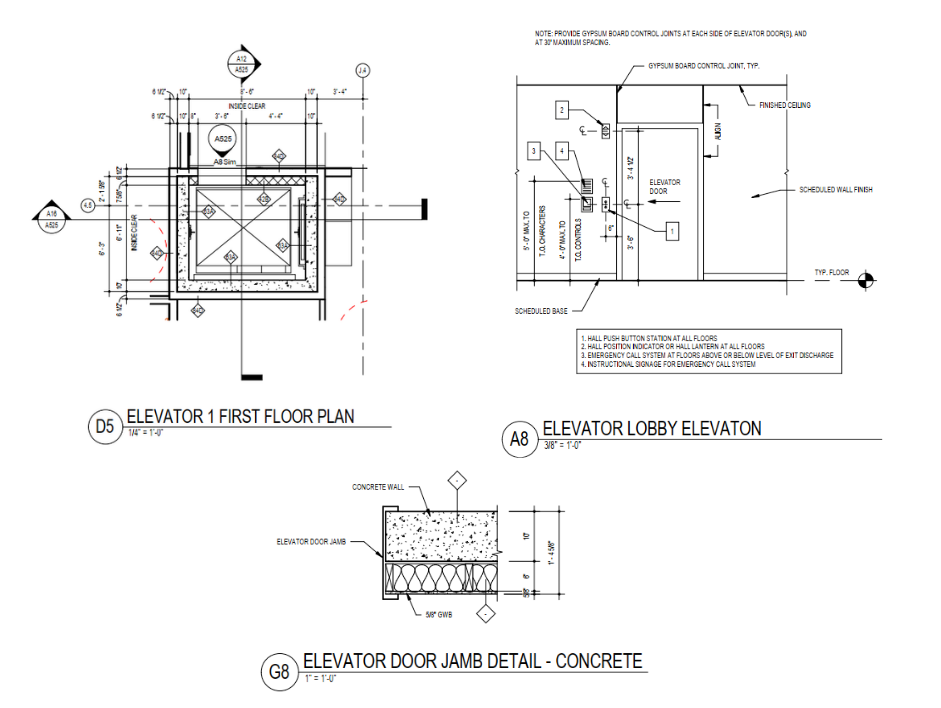
Picture the last set of elevator details you pulled from your standard library. The frame is 2 inches wide. It’s always been 2 inches wide. You dropped it in, moved on, and didn’t think about it again. Neither did anyone else—until the elevator submittals came in.
That’s when the problem shows up. And by then, it’s someone else’s problem to solve.
The Specification Leaves the Door Open
Elevator manufacturers don’t all build to the same standard frame width. Right now, it’s cheaper for most manufacturers to mount call buttons and lanterns directly on the frame rather than wall-mounting them. This shift has caused "standard" sizes to vary wildly:
| Manufacturer | Typical Standard Frame Width | Impact on Rough Opening (Total Width) |
| Otis | 2" to 2.75" | Minimal deviation from 2" standard details. |
| thyssenkrupp (TKE) | 2" to 4" | Highly variable; can add up to 4" of total width. |
| KONE | 3" | Adds 2" of total width over 2" details. |
| Schindler | 4" to 4.75" | Can add up to 5.5" to the total out-to-out width. |
Unless your spec says otherwise, the GC is going to get bids from all of these manufacturers, and each one is going to bid their own standard frame size.
What That Does to Everything Downstream
Here’s where it hits the smoke curtain contractor, the swing door contractor, or anyone else fitting an assembly to that opening.
Your standard detail shows a 48-inch door with a 2-inch frame on each side. That puts the out-to-out of the frame at 52 inches. That’s what the smoke curtain sub was told to price.
Then the submittals come in. Schindler got the job. Their frame is 4.75 inches wide. The out-to-out is now 57.5 inches. The smoke curtain that was bid at 52 inches just grew by 5.5 inches. Because the unit is wider, the housing is wider, and the motor requirements might even change.
That triggers a change order. Not because anyone did anything wrong, but because the "standard detail" didn't account for the manufacturer's reality.
The Fix Is Simple: Define the Max Width
This problem disappears entirely with one line in the specification. Whether you are following IBC Section 3006 for smoke protection or coordinating fire-rated entrances, you must define the geometry early.
Add this to your Elevator Specification:
"Elevator hoistway entrance frames shall not exceed [X] inches in width."
Define the dimension and put it in writing. This ensures every downstream contractor—from those providing UL 1784 rated smoke curtains to the finish carpenters—is working from the same number.
The Bottom Line
Standard details make a practice scalable, but they assume a "standard" that stopped being reliable a long time ago. One line in the spec is all it takes to keep this from becoming a budget-busting problem at a stage when there’s no easy solution.
Have questions about smoke curtain coordination or how IBC frame requirements affect your next project? Reach out directly at hello@thesmokecurtainguy.com.
This post started as a voice dictation—me talking through what I know after 20+ years in the field. It was edited and formatted with AI assistance to meet modern AEO standards. The expertise is mine.
— John McPhail, The Smoke Curtain Guy
John
Technical expert